Explore the history and important events behind the long-standing Middle East conflict between Israel and Palestine from 1947 to today.
Last Updated
October 11, 2023

Smoke rises in Gaza following Israeli strikes on October 9, 2023.
Source: Mohammed Salem / Reuters
The conflict between Israel and Palestine reflects a longstanding struggle in the territory encompassing the land between the Jordan River to the east and the Mediterranean Sea to the west. This conflict has deep historical roots, shaped by statehood claims from Israelis and Palestinians which have been supported by various international agendas and activities over time.
The Israeli-Palestinian conflict dates back more than a century, with flashpoints building from the United Nations’ 1947 initial Partition Plan to the 1973 Yom Kippur war, and more.
Despite continued efforts at brokering peace—including the 1979 Camp David Accords, the Oslo Accords of the 1990s, and the 2020 Abraham Accords—conflict has persisted.
This timeline explores some of the prominent moments in the conflict from 1947 to today.
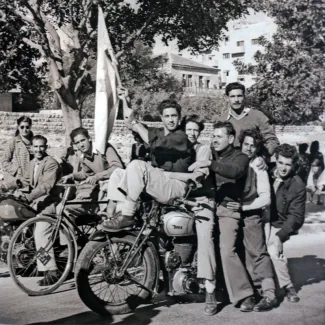
Jews celebrate the Partition Plan in Jerusalem on November 29, 1947.
Universal History Archive
UN Partition Plan of Palestine
The UN General Assembly passes Resolution 181 calling for the partition of Palestine into two states, one Jewish and one Arab. The resolution also envisions an international, UN-run body to administer Jerusalem. Palestine had been under the military and administrative control of the United Kingdom (known as a mandate) since the 1917 defeat of the Ottoman Empire in World War I. Civil strife and violence between the Jewish and Arab communities of Palestine intensifies.
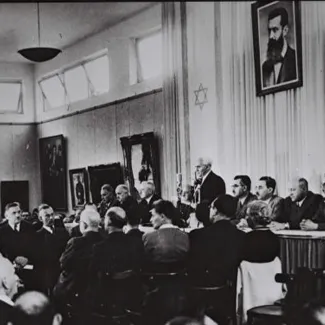
David Ben-Gurion, flanked by the members of his provisional government, reads the Declaration of Independence in the Tel Aviv Museum Hall.
Israel GPO
Israel Declares Independence
Israel declares its independence as the British rule comes to an end. Sparked by Israel’s declaration of independence, the first Arab-Israeli war begins. Egypt (supported by Saudi Arabian, Sudanese, and Yemeni troops), Iraq, Jordan, Lebanon, and Syria invade Israel. The fighting continues until 1949, when Egypt, Israel, Jordan, Lebanon, and Syria signed armistice agreements.
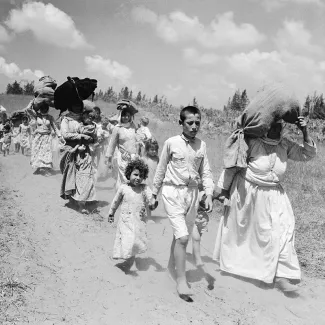
Palestinian women and children hike toward Arab-controlled territory in the West Bank, on June 26, 1948.
Bettmann / Getty Images
UN Addresses Palestinian Displacement
Over the course of the Arab-Israeli war, approximately seven hundred thousand (though some say as many as one million) Palestinian refugees flee their homes in an exodus known to Palestinians as the Nakba, or catastrophe. Israel wins the war, retaining the territory provided to it by the United Nations and capturing some of the areas designated for the Palestinian state. Israel gains control of West Jerusalem, Egypt gains the Gaza Strip, and Jordan gains the West Bank and East Jerusalem, including the Old City and its historic Jewish quarter. In 1948, the UN General Assembly passes Resolution 194, which calls for the repatriation of Palestinian refugees. Palestinians will later point to Resolution 194 as having established a “right of return” for Palestinian refugees and their descendants. The specific parameters of this return are debated in the decades that follow, given the large number of descendants from the 1948 refugees and the three hundred thousand Palestinians who will flee their homes during the June 1967 war.
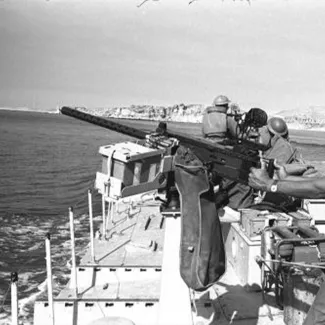
An Israeli gun boat passes through the Straits of Tiran during the Six Day War.
Israel GPO
Israel and several of its Arab neighbors fight the Six Day War. Israel wins a decisive victory: it suffers seven hundred casualties; its adversaries suffer nearly twenty thousand. Israel emerges with control of the West Bank and the Gaza Strip—areas inhabited primarily by Palestinians—as well as all of East Jerusalem. Israel also takes control of Syria’s Golan Heights and the Sinai Peninsula, which is part of Egypt. Israel will stay in the Sinai Peninsula until April 1982.
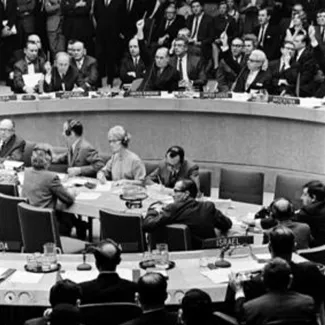
UN Security Council meeting in 1967.
Yutaka Nagata / UN
UN Security Council Resolution calls for Israeli Withdrawal
The UN Security Council (UNSC) passes Resolution 242. It calls for Israeli “withdrawal … from territories occupied in the recent conflict” and for the termination of “states of belligerency and respect for and acknowledgement of the sovereignty, territorial integrity and political independence of every State in the area and their right to live in peace within secure and recognized boundaries.” The resolution establishes the concept of land for peace.
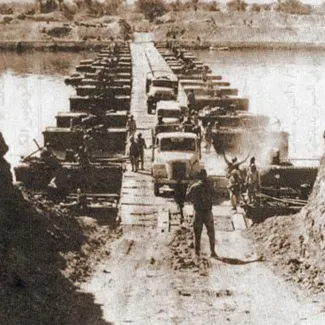
Egyptian forces crossing the Suez Canal in 1973.
CIA
Another Arab-Israeli war, known variously as the Yom Kippur War, the Ramadan War, or the October War, is fought when Egypt and Syria attempt to retake the Israeli-occupied Sinai Peninsula and Golan Heights. Cold War tensions spike as the Soviet Union aids Egypt and Syria and the United States aids Israel. The Organization of the Petroleum Exporting Countries begins an oil embargo on countries that support Israel, such as the United States, and the price of oil skyrockets. The fighting ends after a UN-sponsored cease-fire (negotiated by the United States and the Soviet Union) takes hold. The UNSC passes Resolution 338, which calls for implementing UNSC Resolution 242.
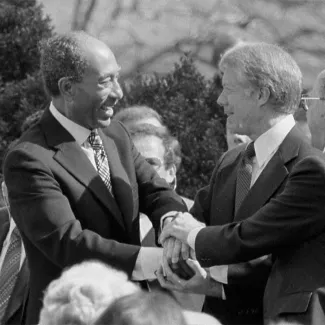
U.S. President Jimmy Carter shakes hands with Egyptian President Anwar Sadat at the signing of the Egyptian-Israeli Peace Treaty at the White House seven months after the Camp David Accords.
Warren K. Leffler / Library of Congress
Israel and Egypt sign the Camp David Accords, which establish a basis for a peace treaty between the two countries. The accords also commit the Israeli and Egyptian governments, along with other parties, to negotiate the disposition of the West Bank and the Gaza Strip.
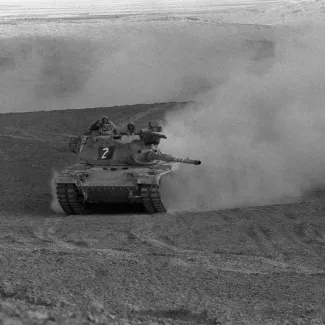
Israeli tank in the Sinai.
François Lochon / Getty Images
Israel Withdraws from the Sinai Peninsula
Egypt and Israel sign a peace treaty, the first between Israel and one of its Arab neighbors. The treaty commits Israel to withdraw from the Sinai Peninsula and evacuate its settlements there. The termination of the state of war between Egypt and Israel leads to the normalization of diplomatic and commercial relations between the two countries. Israel’s prime minister and Egypt’s president exchange letters reaffirming their commitment—outlined in the Camp David Accords—to negotiate the disposition of the West Bank and the Gaza Strip.
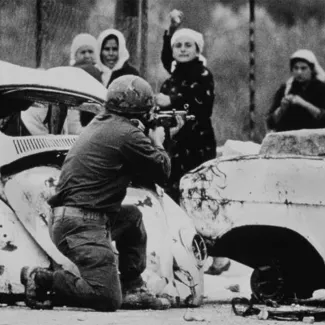
An Israeli soldier takes aim as a Palestinian woman hurls a rock at him from close range on February 29, 1988 at a demonstration following the outbreak of the "intifada" months earlier.
Jim Hollander / Reuters
First Palestinian Intifada
An Israeli driver kills four Palestinians in a car accident that sparks the first Palestinian intifada, or uprising, against Israeli occupation in the West Bank and Gaza. The image of Palestinians throwing rocks at Israeli tanks becomes the enduring image of the intifada. Over the next six years, roughly two hundred Israelis and 1,300 Palestinians are killed.
A Palestinian cleric named Sheikh Ahmed Yassin establishes the militant group Hamas as an offshoot of the Muslim Brotherhood. Hamas endorses jihad as a way to regain territory for Muslims; the United States designates Hamas a foreign terrorist organization in 1997.
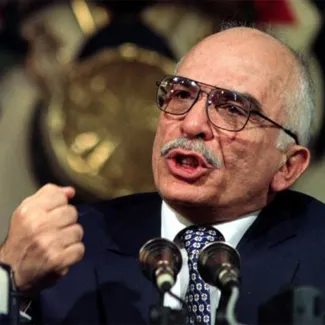
King Hussein of Jordan.
Ali Jareki / Reuters
Jordan Surrenders Claims on West Bank and East Jerusalem
King Hussein of Jordan relinquishes his country’s claims to the West Bank and East Jerusalem in favor of the PLO’s claims. In December of the same year, PLO Chairman Yasir Arafat denounces violence, recognizes Israel’s right to exist, and acknowledges UNSC Resolution 242 and the concept of land for peace. The United States responds to Arafat’s announcement by beginning direct talks with him, though it suspends the talks following a Palestinian terrorist attack against Israel.
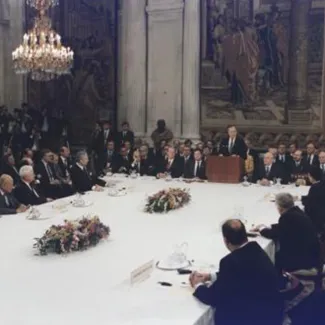
President Bush addresses the Middle East Peace Conference at the Royal Palace in Madrid, Spain on October 30, 1991.
David Valdez / U.S. National Archives
The Madrid Peace Conference
The Madrid Peace Conference begins, sponsored jointly by the United States and the Soviet Union. Israeli, Jordanian, Lebanese, Palestinian, and Syrian delegates attend the first negotiations among these parties. The talks proceed along bilateral tracks between Israel and its neighbors, though the Lebanese join the Syrian delegation and the Jordanian team includes Palestinian representatives. A multilateral track includes the wider Arab world and addresses regional issues. The talks last for two years without any breakthroughs.

Israeli Prime Minister Yitzhak Rabin, Foreign Minister Shimon Peres, and PLO Chairman Yasser Arafat win Nobel Peace Prize in 1994.
Saar Yaacov / Israel GPO
Secret negotiations in Norway result in the Declaration of Principles on Interim Self-Government Arrangements, also known as the Oslo Accords. Before the accords are signed, Israel and the PLO recognize each other in an exchange of letters. Israel and the PLO agree to the creation of the Palestinian Authority to temporarily administer the Gaza Strip and West Bank. Israel also agrees to begin withdrawing from parts of the West Bank, though large swathes of land and Israeli settlements remain under the Israeli military’s exclusive control. The Oslo Accords envision a peace agreement by 1999. Palestinian leader Yasir Arafat, Israeli Prime Minister Yitzhak Rabin, and Israeli Foreign Minister Shimon Peres win the Nobel Peace Prize in 1994 for their efforts on the Oslo Accords.
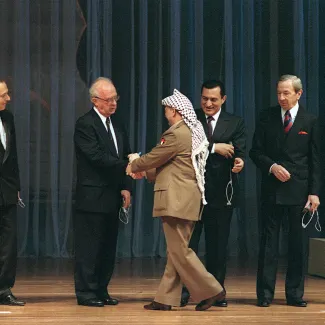
Yasser Arafat, President of Palestine Liberation Organization (PLO) shakes hands with Israeli Premier Yitzhak Rabin at the signing of the Gaza-Jericho Agreement on May 4, 1994.
Patrick Baz / AFP / Getty Images
The Gaza-Jericho Agreement
Israel and the Palestinians sign the Gaza-Jericho Agreement, which begins implementation of the Oslo Accords. The agreement provides for an Israeli military withdrawal from Gaza and Jericho, a town in the West Bank, and for a transfer of authority from Israeli administration to the newly formed Palestinian Authority. The agreement also establishes the structure and composition of the Palestinian Authority, its jurisdiction and legislative powers, a Palestinian police force, and relations between Israel and the Palestinian Authority. Yasir Arafat returns to the Gaza Strip after a long absence.
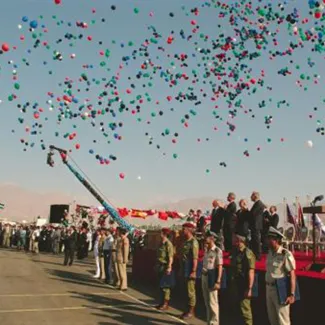
Israel-Jordan Peace Treaty ceremony at the Arava Terminal at the southern end of the two countries' border in 1994.
Sa'ar Ya'acov / Israel Government Press Office Photo
Israel and Jordan Sign a Peace Treaty
Israel and Jordan sign a peace treaty, settling their territorial dispute and agreeing to future cooperation in sectors such as trade and tourism. This is Israel’s second peace treaty with an Arab state. The treaty accords special administrative responsibilities for Jerusalem’s Muslim holy places to Jordan.
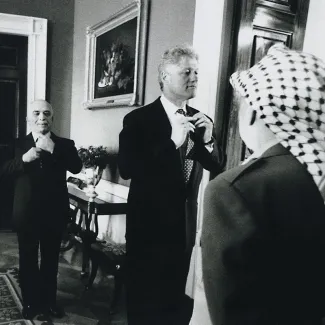
U.S. President Bill Clinton, Israeli Prime Minister Yitzhak Rabin, Egyptian President Hosni Mubarak, Jordan's King Hussein, and PLO Chairman Yasser Arafat on September 28, 1995 after signing the Israeli-Palestinian Interim Agreement at the White House.
Reuters
Israeli and Palestinian negotiators sign the Interim Agreement, sometimes called Oslo II. It gives Palestinians control over additional areas of the West Bank and defines the security, electoral, public administration, and economic arrangements that will govern these areas until a final peace agreement is reached in 1999.
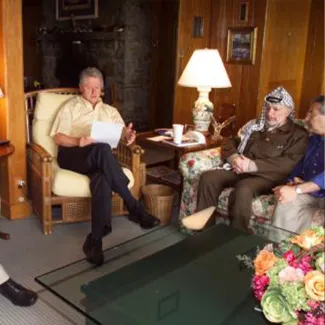
U.S. President Clinton meets with Israeli Prime Minister Barak and Palestinian President Yasser Arafat at Camp David in Maryland on July 25, 2000.
Reuters
President Bill Clinton hosts Israeli and Palestinian leaders for talks at Camp David. Reports indicate that Prime Minister Barak is prepared to accept, among other things, Palestinian sovereignty over some 91 percent of the West Bank and certain parts of Jerusalem. The deal would include a land swap in which some Israeli land would go to the Palestinians in compensation for the remaining 9 percent of the West Bank, which would go to Israel. Two weeks of intensive discussion, however, fail to produce an agreement. President Clinton blames Arafat for the failure. Before leaving office several months later, Clinton lays out proposals for both sides. Talks between them continue, but without success.
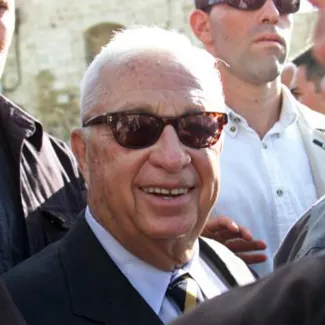
Israeli right-wing political leader, Ariel Sharon smiles after making a controversial visit to the Temple Mount (known to Muslims as al-Haram al-Sharif, one of Islam's holiest sites) on September 28, 2000.
Natalie Behring / Reuters
The Second Palestinian Intifada
Israeli politicians, including Ariel Sharon, a controversial retired Israeli general, visit the Temple Mount/Haram al-Sharif. Palestinians view the visit as an effort to change the status quo at the holy site. The ensuing demonstrations turn violent, marking the beginning of a second intifada. It will last until 2005 and be markedly more violent than the first intifada. Four thousand Palestinians and one thousand Israelis die.

Israeli rescue workers search the scene of a suicide bombing in Netanya on May 19, 2002.
Nir Elias / Reuters
A terrorist attack kills thirty people at a Passover celebration at a hotel in the Israeli city of Netanya. As a result, the Israeli military reoccupies portions of the West Bank, including the city of Ramallah, where the Palestinian Authority is located and where Yasir Arafat has his West Bank headquarters.
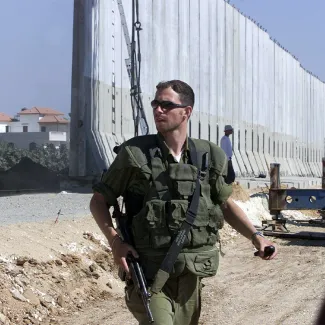
An Israeli soldier guards the new fence built by Israel at the outskirts of the Palestinian West Bank city of Qalkilya, on June 23, 2002.
Nir Elias / Reuters
Israeli West Bank Barrier Building Begins
Israel begins building a security barrier in the West Bank to protect Israeli cities and towns from terrorist attacks. The barrier, which is a wall in some stretches and a fence in others, is controversial because in places it cuts deep into West Bank territory to protect settlements. Palestinians are cut off from Jerusalem, some Palestinian villages are sliced in half, and some Palestinians are unable to get to work or school as a result of the security barrier’s path. Israel’s Supreme Court forces changes in the barrier’s route, but the barrier continues to impede Palestinian movement and commerce in certain areas.
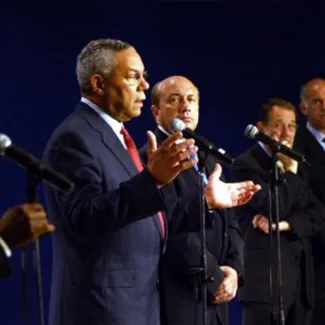
U.S. Secretary of State Colin Powell gives a joint news conference with other leading diplomats about issues in the Middle East at a World Economic Forum meeting in Jordan in 2003.
Ali Jarekji / Reuters
The Quartet, an informal group created to pursue Middle East peace and composed of the United States, Russia, the United Nations, and the European Union, puts forth a Road Map for Peace based on the outline President Bush offered in his 2002 speech. The road map lays out a plan for peace based on Palestinian reforms and a cessation of terrorism in return for an end to Israeli settlements and a new Palestinian state.
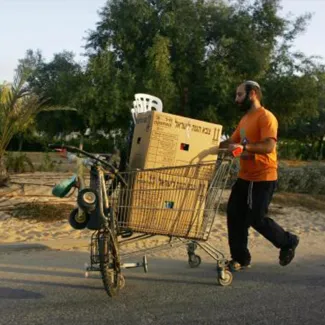
On August 21, 2005, a Jewish settler carts away his belongings before Israeli soldiers arrived to evacuate the Jewish settlement of Katif in the Gaza Strip.
Paul Hanna / Reuters
Israeli Disengagement With Gaza
Israel begins a unilateral withdrawal of settlers and military forces from the Gaza Strip. The Israeli military remains in control of Gaza’s borders (except the Gaza-Egypt border, which is controlled by Egypt), airspace, and coastline. After Israel’s withdrawal, Hamas, Palestinian Islamic Jihad, and other smaller militant groups fire rockets from Gaza into southern Israel.
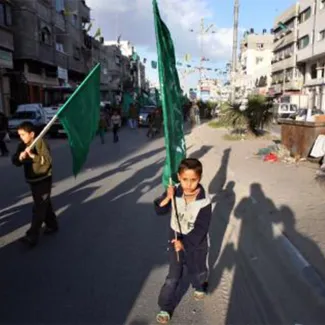
A Palestinian boy marches with a Hamas flag after the Palestinian election in Gaza Strip on January 26, 2006.
Ahmed Jadallah / Reuters
Hamas Expands Power in Gaza
Hamas defeats Fatah in Palestinian elections. The United States and other countries suspend their aid to the PA because they consider Hamas to be a terrorist organization. Fatah and Hamas make a deal to govern the West Bank and Gaza Strip together. The deal quickly fails, and Hamas takes over the Gaza Strip in 2007.
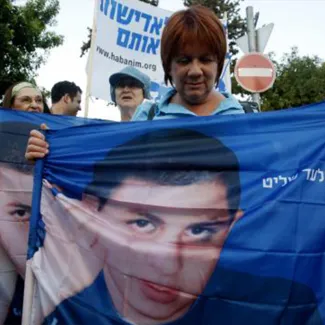
In 2008, people in Jerusalem attend a rally marking two years since Israeli soldier Gilad Shalit was captured by Palestinian militants.
Ronen Zvulun / Reuters
Gilad Shalit Taken Hostage
Hamas operatives kidnap an Israeli soldier named Gilad Shalit on Israeli soil near the Gaza Strip. The Israeli military tries and fails to free him. He is held in captivity in Gaza until Israel—with the help of Egypt and the United States—negotiates his release in 2012.
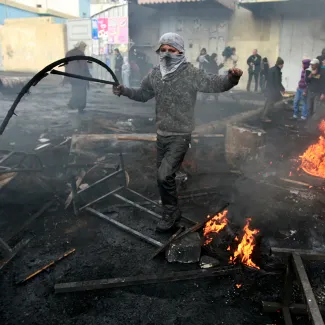
A Palestinian protests the Israeli offensive in Gaza by throwing stones at Israeli border police officers at a refugee camp in the West Bank near Jerusalem on December 29, 2008.
Ammar Awad / Reuters
Israel Attacks the Gaza Strip
Israel attacks the Gaza Strip following nearly eight hundred rocket attacks from Gaza on Israeli towns in the months of November and December. The war lasts less than a month but kills hundreds of civilians, in addition to hundreds of combatants, and sparks international criticism.
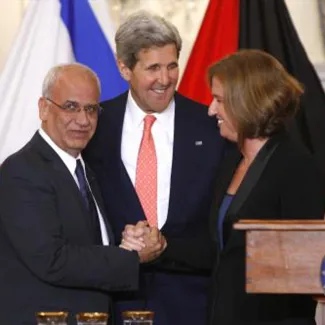
Chief Palestinian negotiator Saeb Erekat, U.S. Secretary of State John Kerry, and Israel's Justice Minister Tzipi Livni shake hands at the end of negotiations in Washington D.C. on July 30, 2013.
Jonathan Ernst / Reuters
Negotiations Face Continued Hurdles
Secretary of State John Kerry seeks to restart final status negotiations. The process begins with Israel’s agreement to release 104 Palestinian prisoners and Palestinians’ agreement not to use their new observer state status at the United Nations to advance the cause of statehood. Negotiations between Israel and the Palestinian Authority collapsed in April 2014 over such issues as Israeli settlement growth, the status of a final round of prisoners, and Palestinian attempts to join several international organizations.
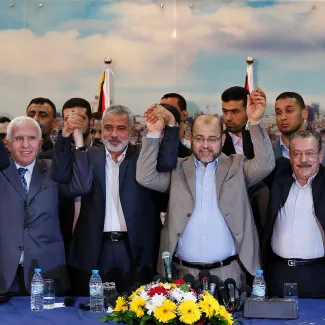
Senior Fatah official Azzam Al-Ahmed, head of the Hamas government Ismail Haniyeh, and senior Hamas leader Moussa Abu Marzouq raise their hands after announcing a reconciliation agreement in Gaza City on April 23, 2014.
Suhaib Salem / Reuters
Tensions Between the PLO and Hamas
The PLO and Hamas sign an agreement to form a unity government. Tensions between the factions remain, however, and no unity government is formed. Gaza and the West Bank remain disconnected and under the control of rival Palestinian leaderships.
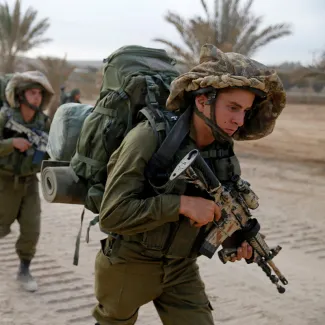
On August 2, 2014, Israeli soldiers walk outside the Gaza Strip on their way into the area as part of an offensive against Palestinian militants.
Baz Ratner / Reuters
Operation Protective Edge
After tit-for-tat attacks on Israeli and Palestinian civilians by extremists on both sides, Israel invades the Gaza Strip. The operation, code-named Protective Edge, lasts for fifty days, killing about two thousand Gazans, sixty-six Israeli soldiers, and five Israeli civilians. Unlike the conflicts from 2008 to 2009 and in 2012, Palestinian rocket fire targets major Israeli cities. The war ends after the United States, in consultation with Egypt, Israel, and other regional powers, brokers a cease-fire.
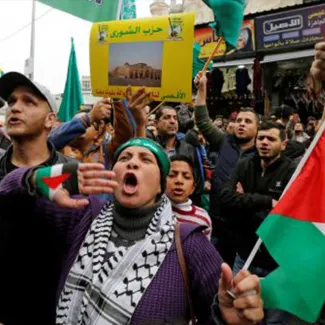
On December 29, 2017, people in Amman, Jordan protest U.S. President Donald Trump's recognition of Jerusalem as Israel's capital.
Muhammad Hamed / Reuters
The U.S. Formally Recognizes Jerusalem as the Capital of Israel
Changing long-standing U.S. policy, President Trump formally recognizes Jerusalem as the capital of Israel. He also pledges to move the U.S. embassy from Tel Aviv to that city, though this is not set to occur immediately. Numerous foreign leaders, including those of Egypt, France, Saudi Arabia, Turkey, and the United Kingdom, along with UN Secretary-General Guterres, criticize the policy change. It also sparks protests and violence throughout East Jerusalem, Gaza, and the West Bank, as well as in Egypt, Jordan, Iran, and Iraq. In January 2018, Abbas declines to meet with U.S. Vice President Mike Pence during Pence’s trip to the region.
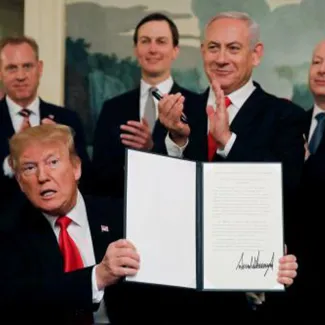
U.S. President Donald Trump holds a proclamation recognizing Israel's sovereignty over the Golan Heights as he is applauded by Israel's Prime Minister Benjamin Netanyahu and others during a ceremony at the White House in Washington D.C. on March 25, 2019.
Carlos Barria / Reuters
The U.S. Recognizes Israeli Sovereignty over the Golan Heights
The Trump administration recognizes Israeli sovereignty over the Golan Heights, which Israel had formally annexed from Syria in 1981. The United States is the first country other than Israel to recognize Israel’s sovereignty over the territory.
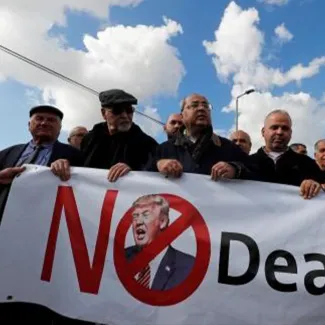
Ahmad Tibi, a Palestinian member of the Israeli Parliament, takes part in a protest against U.S. President Donald Trump's Middle East peace plan in Baqa Al-Gharbiyye, Israel on February 1, 2020.
Ammar Awad / Reuters
Trump Administration Launches Proposed Peace Plan
Trump unveils his administration’s proposed Israeli-Palestinian peace plan, crafted by U.S. and Israeli diplomats without Palestinian input. The plan calls for a two-state solution with significant economic aid to the Palestinians. Many analysts criticize the plan as being one sided, stipulating impossible requirements for Palestinian statehood and paving the way for Israeli annexation of the West Bank. Palestinian authorities reject the plan immediately. Following the plan’s announcement, Netanyahu announces Israel’s plan to annex portions of the West Bank as outlined in Trump’s proposal.
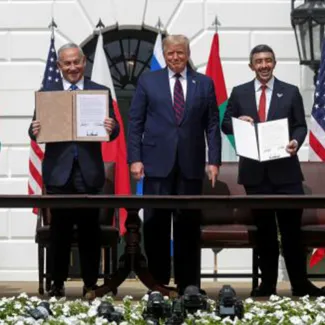
Israel's Prime Minister Benjamin Netanyahu and United Arab Emirates (UAE) Foreign Minister Abdullah bin Zayed display their copies of signed agreements while U.S. President Donald Trump looks on as they participate in the signing ceremony of the Abraham Accords, at the White House on September 15, 2020.
Tom Brenner / Reuters
Relations between Some Arab Countries and Israel Normalize
Bahrain and the United Arab Emirates agree to normalize diplomatic relations with Israel, becoming the first Arab countries to do so in over twenty-five years. In return, Israel announces the suspension of its plans to annex territory in the West Bank. Morocco and Sudan subsequently also sign on to the agreement and normalize relations with Israel.
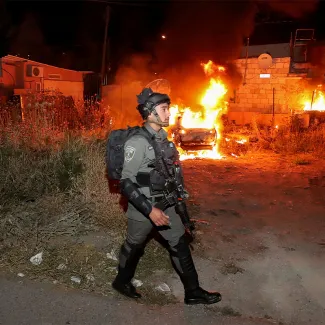
An Israeli border policeman walks as a car belonging to Jewish settlers burns amid tension over the possible eviction of several Palestinian families from homes on land claimed by Jewish settlers in East Jerusalem on May 6, 2021.
Ammar Awad / Reuters
2021 Israel-Palestine Crisis
Evictions of Palestinians in East Jerusalem and clashes at al-Aqsa Mosque spark conflict between Israel and Hamas. Over two hundred people in Gaza and at least ten in Israel die. The Biden administration helps mediate a truce and restores some U.S. aid and diplomatic contact with the Palestinians.

A Palestinian man checks a house that was damaged during Israel-Gaza fighting in Gaza City on August 8, 2022.
Suhaib Salem / Reuters
Deadly Year in Israeli-Palestinian Conflict
Israel launches a counterterrorism operation in the West Bank in response to attacks by Palestinians against Jewish Israelis. The operation and resulting resurgence contribute to the deadliest year for both sides since 2005, an uptick in violence that only turned out to rise in 2023.
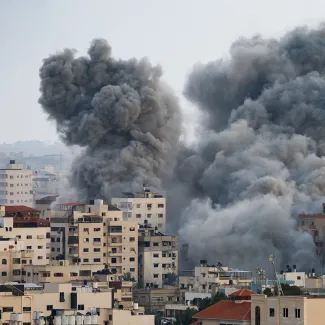
Smoke rises in Gaza following Israeli strikes on October 9, 2023.
Mohammed Salem / Reuters
Hamas Launches Surprise Attack on Israel
Israel faced domestic turmoil over government moves to overhaul the judiciary, all while 2022 marked a renewed level of violence between Israelis and Palestinians. The first nine months of 2023 were characterized by a steady trend of clashes in the West Bank, including nearly daily Israeli incursions.
On October 7th, 2023, Hamas launched an unprecedented surprise attack on Israel, leading to an explosion of violence. According to Israeli Media, the initial strikes of the conflict led to at least 250 people killed and 1,500 injured in Israel, making it the deadliest attack in the country in decades. The Palestinian Health Ministry, in turn, reported that 232 people in the Gaza Strip were killed and 1,700 wounded in Israeli strikes.
Hamas’s military leader, Mohammed Deif, said the group undertook its assault because of Israel’s long-running blockade of Gaza, its occupation of Palestinian lands, and its alleged crimes against Muslims, including the desecration of the Al-Aqsa Mosque in Jerusalem. Israel's Netanyahu in turn vowed to respond with a 'mighty vengeance' against Hamas. The October 2023 conflict between Israel and Hamas marks the most significant escalation of the ongoing Israeli-Palestinian conflict in several decades.