From CNN’s Jillian Sykes
Through a series of airstrikes in Gaza, Hadeel Masseoud says she has lost at least 14 family members, including a 2-month-old child.
Masseoud, who is a Georgia resident, told CNN on Saturday that she has “lost track” as the death toll continues to increase.
“I don’t think hurt even begins to describe what I feel. It’s immense pain and anger,” she said.
One airstrike killed six Masseoud family members at their home earlier this month, she said. Another relative wasn’t home at the time of the attack and returned to find his loved ones dead. Masseoud said the man then suffered a heart attack and was hospitalized.
“They don’t have clean water. The hospitals don’t have anesthesia. I’m going to assume that he’s not doing well,” she told CNN.
Since then, at least eight additional family members have been killed in other airstrikes, Masseoud said.
“How many more Palestinians need to die before it’s enough? What’s it going to take?” she said.
Masseoud was born in the United States and hasn��t met her extended family in Gaza, but said her father has remained very close to them.
“We were thinking about going together to Gaza for Christmas so I could meet them for the first time,” she said.
Masseoud’s father has roots in Gaza but grew up in Lebanon. He moved to the United States to provide better opportunities for his children but has helped financially support his extended family for many years, she said.
“He is 82 years old. This is going to break him,” Masseoud told CNN.
Masseoud expressed her frustration with some of the rhetoric surrounding the situation in Gaza, saying it has made her family feel extremely unsafe.
“The rhetoric that I see is disgusting. The dehumanization of the Palestinian people is disgusting,” she said. “We are not Hamas! They’re innocent civilians. They don’t have water! How is this justified?”
Masseoud said those spreading hateful remarks “have blood on their hands.”
Satellite photos show trucks leaving Gaza after dropping off aid, with more lined up at border crossing
From CNN's Paul P. Murphy
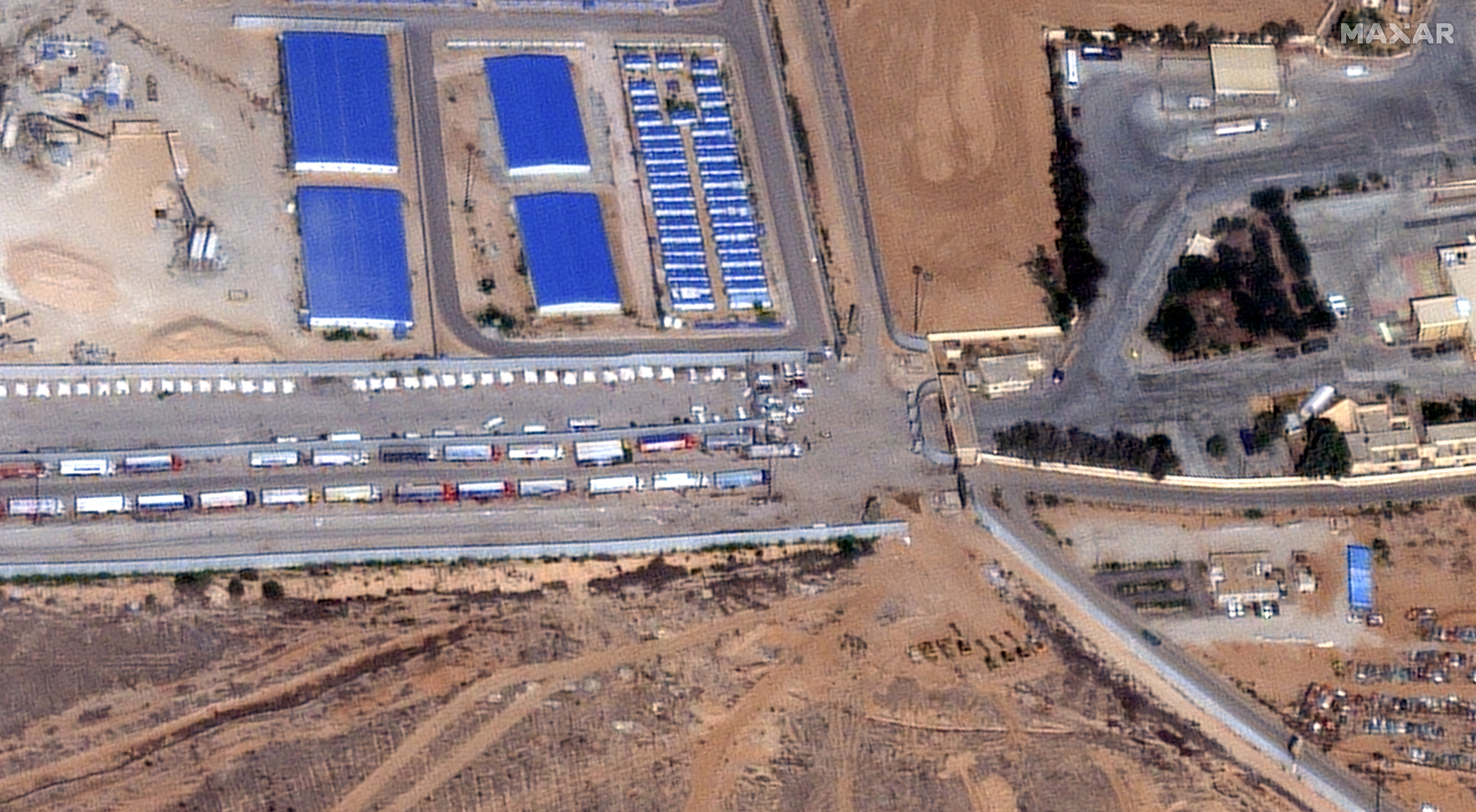
A satellite photo taken Saturday morning captured aid trucks returning from Gaza and others still lined up at the Rafah crossing, which was briefly opened earlier.
The image was taken at 11:22 a.m. local time (4:22 a.m. ET), more than an hour after the crossing opened for aid. In it, empty trucks are seen crossing back into Egypt.
The border crossing was opened for a short window to let 20 aid trucks cross into the Gaza Strip from Egypt. While many have welcomed the development, rights groups stress that more aid is desperately needed for over 2 million people within the besieged enclave.
World Health Organization Director-General Tedros Adhanom Ghebreyesus was one of those who warned Saturday that "needs are far higher."
US Secretary of State Antony Blinken also called for the crossing to remain open “to enable the continued movement of aid that is imperative to the welfare of the people of Gaza” in a statement Saturday.

Egypt says Israel-Hamas war revealed "shortcoming" in international approach to crises
From CNN's Radina Gigova and Caroline Faraj
After a peace summit in Cairo aimed at de-escalating the war between Israel and Hamas, Egypt criticized the international community for not doing enough to address the root causes of the conflict.
"The international scene over the past decades has revealed a serious deficiency in finding a just and lasting solution to the Palestinian issue, because it sought to manage the conflict, and not end it permanently," reads a statement issued by the Egyptian presidency on Saturday.
"The ongoing war has also disclosed a shortcoming in the values of the international community in addressing crises," it said. "While we see one place rushing and competing to promptly condemn the killing of innocent people, we find incomprehensible hesitation in denouncing the same act in another place. We even see attempts to justify this killing, as if the life of the Palestinian human being is less important than that of other people."
Egypt hopes that in light of the current crisis "a new political spirit and will" will emerge that "pave the way for unlocking a real and serious peace process," reads the statement.
"This shall lead, in a short period of time, to the establishment of an independent Palestinian State, along the June 1967 borders, with East Jerusalem as its capital," it said.
Blinken reaffirms US support for Lebanon as tensions in Middle East remain high
From CNN’s Lauren Koenig
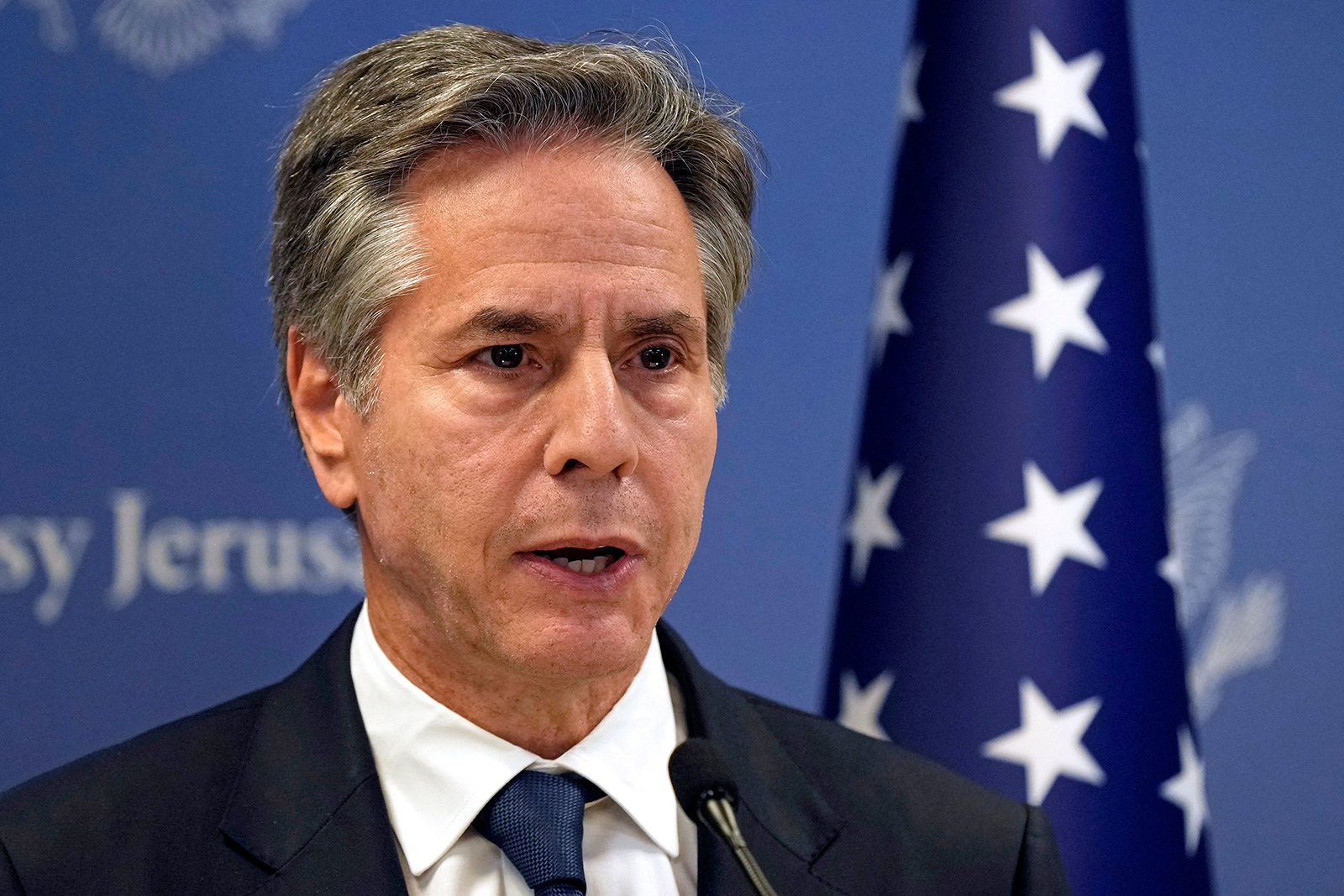
As Israeli and Hezbollah forces have recently traded artillery fire on the Israel-Lebanon border, US Secretary of State Antony Blinken reiterated US support for the Lebanese Armed Forces and Internal Security Forces in a phone call Friday.
US State Department spokesperson Matthew Miller said on Saturday that in the call, Blinken acknowledged “growing concern” over escalating tensions in the Middle East and the potential consequences of Lebanon being drawn into the conflict. The secretary also offered condolences to the Lebanese people who have lost loved ones.
Here's what to know about Hezbollah, the powerful, Iran-backed paramilitary force in Lebanon.
Final joint statement won't be issued following Cairo peace summit due to "differences," officials say
From CNN's Caroline Faraj
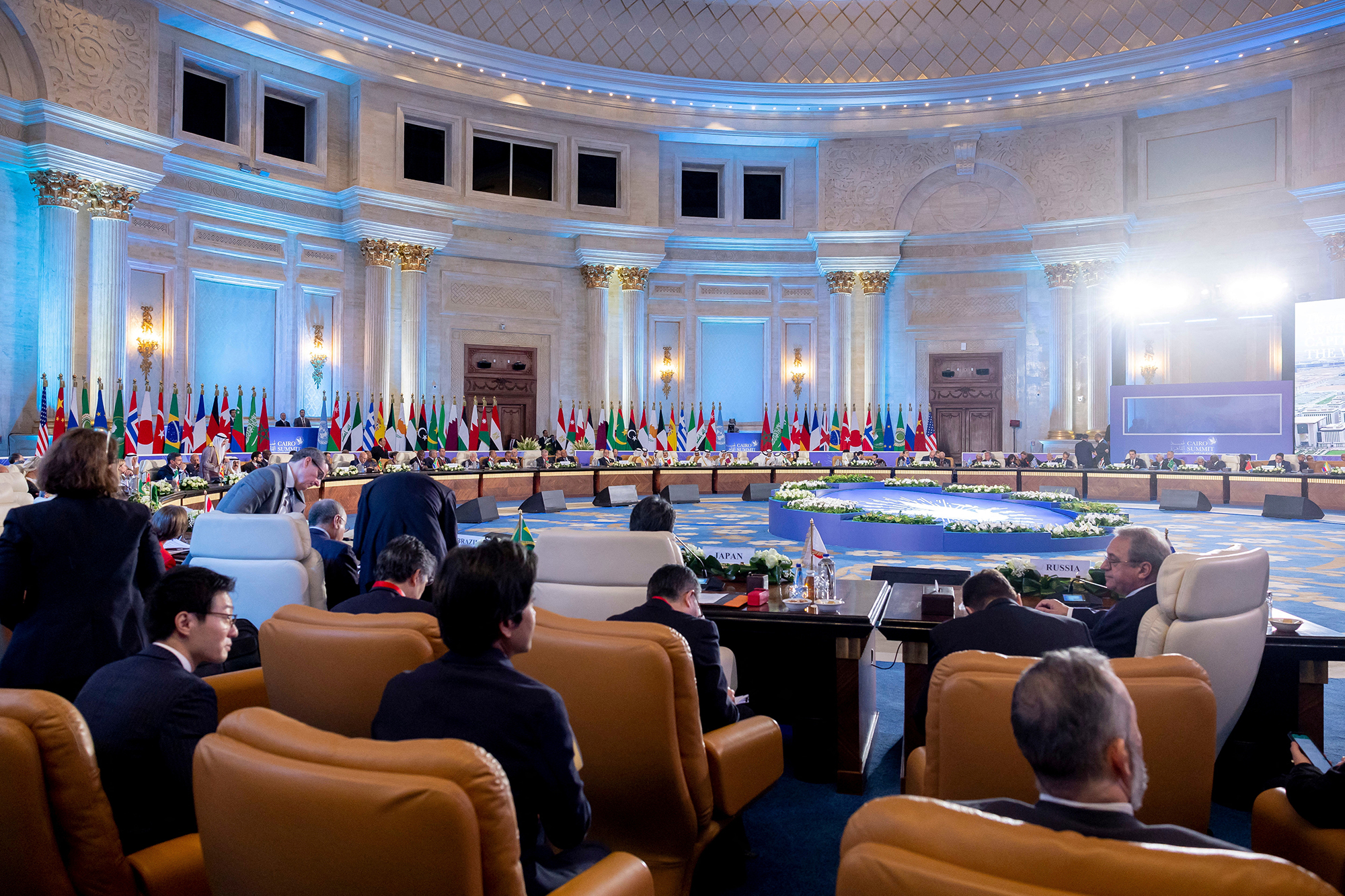
A final joint statement won't be issued following Saturday's Cairo peace summit due to "differences" between the delegations on the wording, an official and a diplomat with knowledge of the matter confirmed to CNN on Saturday.
One of them also said this was expected even before the start of the summit.
About the summit: Egyptian President Abdel Fattah el-Sisi said he gathered world leaders in the Egyptian capital to find a "roadmap" to end the "humanitarian tragedy" unfolding in Gaza.
Palestinian Authority President Mahmoud Abbas joined representatives from 34 countries, the United Nations and international bodies for the summit. Israel was absent from the gathering.
Abbas was defiant in remarks at the meeting, telling the assembled leaders "we will remain on our land."
King Abdullah II of Jordan called for an "immediate end to the war on Gaza," urgent humanitarian aid, the rejection of displacement of Palestinian people and a lasting resolution "on the basis of the two-state solution."
The foreign ministers of France and Germany said Saturday that although Israel has the right to self-defense, it also has a responsibility to protect the civilian population of Gaza.
Analysis: If Israeli troops move into Gaza, what comes next?
Analysis from CNN's Ivana Kottasová

Tal and Zak have no idea how long they’ll be deployed in what the Israelis call “the Gaza envelope,” the area in southern Israel that was attacked by Hamas terrorists two weeks ago.
It could be weeks, it could be months, they said. “It’s the same for everyone. No one knows,” Zak told CNN at a military camp not far from the Gaza border. The two young soldiers, whose surnames CNN isn’t revealing for security reasons, serve in an artillery unit of the Israel Defense Forces that was moved into the area after Hamas militants killed 1,400 people and kidnapped about 200 on October 7.
Their unit is part of a massive buildup of Israeli troops and military material on the Gaza border. On top of its regular force, the IDF has also called up 300,000 reservists who reported to their bases within hours. Across Israel, highways in the vicinity of major bases are lined with thousands and thousands of cars, abandoned by reservists rushing to take up arms.
A ground incursion by Israel into Gaza now seems inevitable. On Thursday, Israeli Defense Minister Yoav Gallant told troops gathered near the border that they would “soon see” the enclave “from the inside,” saying Gaza will “never be the same.”
But what that operation might look like remains unknown. The IDF could launch a full-scale invasion or conduct more precise incursions aimed at recovering hostages and targeting Hamas operatives.
What will happen after that is an even bigger question. While the Israeli leadership speaks about the need to get rid of Hamas, the plan for the future of Gaza and its more than 2 million people people remains unknown.
“There is a consensus that any other option than to totally eliminate Hamas would be terrible, not just for Israel, but for the entire area, and then even globally,” said Harel Chorev, senior researcher in Middle Eastern studies at the Tel Aviv University.
But Hasan Alhasan, a research fellow for Middle East Policy at the International Institute for Strategic Studies, said the plan to annihilate Hamas could be dangerous and complicated – and may have unforeseen consequences.
“Because Hamas is deeply rooted and embedded within Gaza, its society and geography, in order to defeat them, Israel would have to carry out permanent topographic and demographic change of the Gaza Strip – and that has already been happening,” he told CNN.
“The concern, within Egypt especially, is that Israel’s strategy of making the humanitarian situation very difficult in Gaza is ultimately meant to force a mass expulsion of Palestinians from Gaza into the Egyptian Sinai,” Alhasan said, adding that Egypt has the backing of all of the Arab states in that it would not allow this.
“The Jordanians are also concerned that if we see a mass expulsion of Palestinians from Gaza, that this would create a precedent and that Israel’s right-wing government would attempt to solve the Palestinian issue once and for all by expelling them en masse from Gaza into Egypt and from the West Bank into Jordan,” he added.
"Large fire" breaks out in southern Gaza Strip after airstrike, Palestinian Ministry of Interior says
From CNN's Ibrahim Dahman in Gaza
A "large fire" has broken out in the Bani Suhaila area in Khan Younis following an Israeli airstrike on a house, according to a statement from the Palestinian Ministry of Interior in Gaza on Saturday afternoon.
CNN obtained footage from Khan Younis that shows a large plume of smoke rising above the skyline in the southern Gaza Strip city.
The Israel Defense Forces did not have any immediate information on the circumstances of the apparent strike.
France and Germany stress that although Israel has a right to self-defense, it must also protect civilians
From Lina El Wardani and CNN's Niamh Kennedy

The foreign ministers of France and Germany said Saturday that although Israel has the right to self-defense, it also has a responsibility to protect the civilian population of Gaza.
In an address to leaders at the Cairo peace summit, German Foreign Minister Annalena Baerbock emphasized that Hamas bears ultimate responsibility for the "suffering of these past weeks."
"It was Hamas that brought horrendous terror on Israel on Oct 7 committing atrocious crimes. Like any other country in the world, Israel has the right to defend itself and to protect its people against this terror within the framework of international law," Baerbock said.
Baerbock warned that that this "fight against Hamas must be carried out with the greatest possible consideration for the humanitarian situation for the innocent men, women, and children in Gaza."

France's Foreign Minister Catherine Colonna also reiterated that "Nothing justifies terrorism. Facing terrorism, Israel has the right to defend itself."
"Israel, in its legitimate response to the terrorist attack it was victim of, must protect the civilian population in accordance with humanitarian law," Colonna continued.
France "condemns the actions of Hamas" but continues to "support the rights of the Palestinian people like we have always done," Colonna remarked, adding that France will soon send an additional 10 million euros ($10.6 million) in aid to Palestinians.
US citizen still stranded in Gaza despite several dangerous attempts to reach Egypt
From CNN’s Raja Razek
Abood Okal, a US citizen stranded in Gaza with his family and 1-year-old son, says after several attempts to cross from the besieged enclave into Egypt, there is still no sign his family can evacuate Saturday.
Okal and his family, who had traveled from Massachusetts to Gaza, followed instructions from the US State Department and went to the Rafah crossing in southern Gaza Saturday morning, he told CNN's Amara Walker.
The family has been there since 9 a.m. local time (2 a.m. ET), Okal said, noting that a message from the State Department indicated the crossing would open at 10 a.m. local time.
"It's basically 3:15 (local time) right now, and there is no sign of the crossing open," he said. "Aid trucks have come through and entered Gaza, and yet here is not updated information from the State Department or the US Embassy in Cairo regarding our situation."
What we know: Gaza is blockaded by land, air and sea by Israel, which has declared war on its Hamas rulers for a brazen attack on October 7 that killed 1,400 people. The Rafah crossing to Egypt is the only viable option for Palestinians and foreign nationals trying to leave Gaza.
While the crossing opened briefly Saturday to allow a limited amount of humanitarian aid through, it has remained closed to evacuees. The US has been pressuring Egypt to establish a humanitarian corridor for civilians in Gaza, as well as for Americans and other foreigners. But the process of opening passage has been complicated by the multiple parties involved.
Perilous trips end in frustration: Saturday marks the latest of several attempts by Okal's family to try to cross the border after taking "risky drives" and burning fuel reserves.
He told CNN that he and his family "bake in the sun all day, and then no communication thereafter — only to have the sun set on us, and basically force us to leave back to wherever (we are) sheltering for fear of our lives. This is an extremely dangerous area."
When discussing where the family shelters at night, he said they have "had to run for their lives." The family is now staying close to the border at a "friend of a friend's house" with someone they had never met before, according to Okal.
"We have been staying in a normal single-family home, two floors, with about 40 people sharing everything we can share — from food to drinking supplies," he said.
Food is also scarce, according to Okal, and the family cannot easily find milk for their son. He said he has to go to multiple different markets "at times under shelling and during airstrike" to find milk.
The family is trying to keep their son safe "as much as we can." The child "may not be able to comprehend everything that is happening, but he does pick up on fear" when there is an airstrike, the father said.
"There is no way to try to fool a child that is not safe," he said. "Despite that, we try to stay calm with him."
Okal said his family thought the US government "had our back," and that they would be able to exit, but "that is not how things are translating on the ground."
"We keep getting promised that we will cross over to Egypt and that is not happening, and I don't know why we are stuck in this situation," he said.