Palestinian prime minister tells CNN why he won't condemn deadly October 7 Hamas attack
From CNN's Becky Anderson and Zeena Saifi in Ramallah
Palestinian Authority Prime Minister Mohammad Shtayyeh told CNN that he won't condemn the Hamas attack that killed more than 1,000 people on October 7, saying, "support of Israel blindly is a license for killing."
"I hope that (the) United States does not go into that direction," he added.
In a sit-down interview in Ramallah in the West Bank, Shytayyeh told CNN's Becky Anderson why he was unwilling to condemn the attacks:
"The Palestinian story does not start on October 7," Shtayyeh said. "The Palestinian catastrophe has been there for 75 years, and we have been crying loud, and we have been shouting loud and clear (that) we need a solution."
He went on to say that "condemnation should be (for the) killing of every civilian, every human being that does not deserve to die. We should condemn that."
Shtayyeh claimed that the sentiment of the Israeli people is one of revenge.
"Israel is not under existential threat, and I think that the White House, (President Joe Biden) should call for the parties to sit down and work together (for) a peaceful solution," he said.
Visits by world leaders to Tel Aviv in support of Israel — a reference in part to Biden's visit Thursday and US Secretary of State Antony Blinken's visits in the last week, among others — have "given the greenest of the green light for Israel to continue its attack on Gaza," Shtayyeh said.
International support should be for peace, not aggression, he said.
The prime minister called on a collective international effort led by the United Nations Security Council to end the war.
"What you need is a collective international effort on the side of the members of the Security Council to take the lead in ending the conflict and finding a solution," he said.
UN manages to drive enough water for 22,000 people for one day through Rafah crossing into Gaza
From CNN's Niamh Kennedy in London
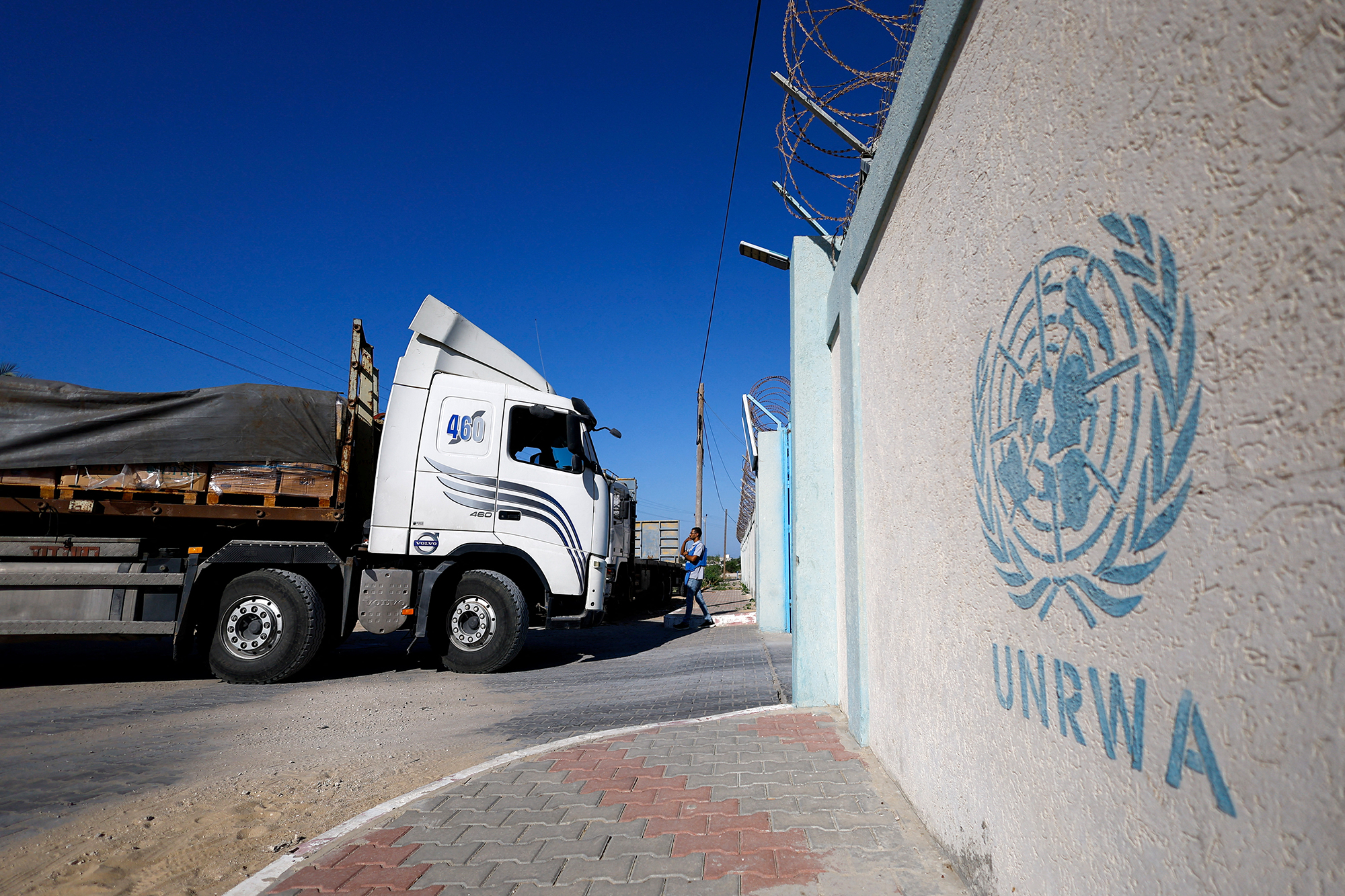
UN children's agency, UNICEF says it managed to drive enough water supplies for 22,000 people for one day through the Rafah crossing into Gaza on Saturday.
"Over 44,000 bottles of drinking water supplied by UNICEF – just enough for 22,000 people for 1 day – were driven through the Rafah Crossing today as part of a 20-truck convoy with the Egyptian Red Crescent, the World Health Organization and the World Food Programme," the UNICEF statement said.
According to UNICEF's Executive Director Catherine Russell, the delivery of water is a "matter of life and death" for the 1 million children in Gaza "facing a critical protection and humanitarian crisis."
"This first, limited water will save lives, but the needs are immediate and immense – not just for water, but for food, fuel, medicine, and essential goods and services. Unless we can provide humanitarian supplies consistently, we face the real threat of life-threatening disease outbreaks," Russell added.
The nearly two-week-long conflict has wrought severe damage on Gaza's water and sanitation systems with water production capacity currently at 5% of normal levels, UNICEF said.
"The nearly 2.3 million residents in Gaza are now surviving on 3 litres of water per person per day," UNICEF added.
The agency issued an urgent call for all access crossings into Gaza to be opened to allow the wider delivery of humanitarian aid alongside the movement of aid workers and urgent medical cases in Gaza who require critical medical care.
Children in particular must be "unconditionally" protected from harm, Russell said, highlighting once again the need for humanitarian agencies such as UNICEF to be able to "safely and predictably deliver assistance to children and families in Gaza who are in desperate need."
Some context: The Rafah crossing was briefly opened on Saturday morning to allow the first convoy of aid trucks to enter the besieged Gaza Strip.
Humanitarian aid had been stuck in Egypt for days with Gaza plunged into a worsening crisis.
World Food Programme says situation in Gaza is "catastrophic" and calls for more aid to be let through
From CNN’s Eve Brennan in London
The World Food Programme (WFP) says aid deliveries to Gaza must not stop, after the first delivery of aid was allowed into the besieged strip on Saturday morning.
A convoy of 20 trucks passed through the Rafah crossing to deliver humanitarian aid to the coastal enclave where a crisis is escalating rapidly.
WFP Executive Director Cindy McCain told CNN’s Isa Soares that starvation is "rampant" in Gaza, adding that the organization needs to continue sending more trucks into the impoverished territory to "get to the millions of people who are literally going to starve to death."
The situation in Gaza is "catastrophic" due to the lack of food, water, electricity, and fuel. "It’s like a perfect storm of the humanitarian disaster," she continued.
"This cannot be the last convoy," said McCain, "there are too many lives at stake."
Blinken calls for the Rafah crossing to remain open
From CNN's Aileen Graef
US Secretary of State Antony Blinken called for the Rafah crossing to remain open “to enable the continued movement of aid that is imperative to the welfare of the people of Gaza” in a statement Saturday.
Blinken thanked Egypt, Israel and the United Nations for help facilitating the 20-truck convoy transporting humanitarian assistance to Gaza, which has been running out of food, water and medical supplies.
He said the crossing should remain open and the US will “stress the importance of adhering to the law of war.”
“Civilian lives must be protected, and assistance must urgently reach those in need. We will continue to work closely with partners in the region to stress the importance of adhering to the law of war, supporting those who are trying to get to safety or provide assistance, and facilitating access to food, water, medical care, and shelter for citizens wherever they are located in Gaza,” he said.
Blinken also said the US would continue to work to get American citizens safely out of Gaza.
Caritas mourns worker and her family killed in Gaza church compound strike
From CNN's Jomana Karadsheh, Kareem El Damanhoury and Radina Gigova
An employee at Caritas, a network of Catholic charitable organizations, who was killed along with her family in the Greek Orthodox church compound that officials in Gaza say was hit in an Israeli airstrike on Thursday night, was committed "to making a difference in the world, the group said Saturday.
Viola Al 'AMash (Al Souri), her husband Abdel Nour Al Souri, their daughter Alya, as well as Viola's sister, her sister's husband, and her sister's two children, were all killed when the church was struck, according to Caritas.
"Viola's journey was marked by dedication and perseverance, as she successfully completed her graduate degree in medical analysis at Al-Azhar University in Gaza," said Anton Asfar, Secretary General of Caritas Jerusalem.
Asfar said the 26-year-old employee had worked with Caritas since 2021, "where she served as a lab technician with the mobile medical teams, tending to the needs of the most vulnerable people in Gaza."
"This heart-wrenching event has left a void in the lives of their friends and family, and the community as a whole. Our thoughts and prayers are with those who have been affected by this profound loss, and we remember Viola and her family with deep empathy and sorrow," he said.
In an earlier statement by the organization on Friday, Caritas condemned what it described as "arbitrary and deliberate targeting of civilians and civilian infrastructure" and called for a ceasefire to protect civilians and allow humanitarian aid into the strip.
The Hamas-run Palestinian Ministry of Health in Gaza reported that 17 people were killed in the Israeli airstrike on the church compound.
CNN cannot independently confirm the number of casualties. The Israel Defense Forces on Friday acknowledged that "a wall of a church in the area was damaged” as a result of a strike.
This post has been updated.
Previous CNN reporting from Abeer Salman and Eyad Kourdi.
Aid trucks back in Egypt after delivering aid to Gaza
From Asmaa Khalil in Rafah
Egyptian trucks have unloaded humanitarian aid and returned to the Egyptian side of the Rafah border crossing with Gaza, according to a CNN stringer on the ground.
The Rafah crossing was briefly opened on Saturday morning to allow the first convoy of aid trucks to enter the besieged Gaza Strip.
Humanitarian aid had been stuck in Egypt for days with Gaza plunged into a worsening crisis. The enclave is fast running out of food, water, fuel and medical supplies – all while being pounded by relentless airstrikes.
What is the two-state solution?
From CNN's Lauren Said-Moorhouse and Aditi Sangal
The idea of the two-state solution sounds simple enough – an Israeli state next to a Palestinian state, existing side by side in peace.
It has been the goal of the international community for decades, dating back to the 1947 UN Partition Plan, and many nations say it is the only way out of the conflict.
But progress on the goal has been far from easy, and has stalled in recent years. The two sides have failed to come to an agreement over several issues central to the solution.
Both claim parts, if not all, of the holy city of Jerusalem as their capital. They dispute where to draw borders and they continue to clash over Israeli settlements in occupied territory.
Additionally, what happens to the Palestinian refugees who fled what is now Israel after the 1948 war is a point of contention. The United Nations estimates that there are 5.9 million Palestinian refugees in the world.
It would recognize a 1967 demarcation line known as the Green Line to partition Palestinian and Israeli land, subject to land swaps based on negotiations, and it would divide Jerusalem between the two states.
Jordan's King Abdullah calls for "immediate end to the war on Gaza" and peace "on the basis of the two-state solution"
From CNN's Caroline Faraj and Lauren Kent
ig Abdullah II of Jordan spoke at the Cairo Summit for Peace, specifically addressing European and Western leaders in English to say that "our region came with a message of peace."
He called for an "immediate end to the war on Gaza," urgent humanitarian aid, the rejection of displacement of Palestinian people and a lasting resolution "on the basis of the two-state solution."
"I am outraged and grieved by those acts of violence waged against innocent civilians in Gaza, in the West Bank, and Israel," King Abdullah said. "All civilian lives matter.
"The relentless bombing campaign underway in Gaza as we speak is cruel and unconscionable—on every level. It is collective punishment of a besieged and helpless people," he told the summit. "It is a flagrant violation of international humanitarian law. It is a war crime."
King Abdullah also criticized leaders for their "global silence" and for not holding Israel accountable in previous conflicts.
"It’s been two weeks since Israel put in place the complete siege of the Gaza Strip. And still, for the most part, global silence," he said. "Yet the message the Arab world is hearing is loud and clear: Palestinian lives matter less than Israeli ones. Our lives matter less than other lives.
"Israel is literally starving civilians in Gaza, but for decades, Palestinians have been starved of hope, of freedom, and a future," King Abdullah added, highlighting what he called "the injustices of occupation."
"Israeli leadership must realize that there is no military solution to its security concerns, that it cannot continue to sideline the five million Palestinians living under its occupation, denied of their legitimate rights, and that Palestinians lives are no less valuable than Israeli lives."
He argued that "hardline Israeli leadership" has focused solely on security over peace, which "has empowered extremists on both sides."
"Our collective and unified message to the Israeli people should be: We want a future of peace and security for you and for the Palestinians, where your children and Palestinian children should no longer live in fear," King Abdullah added. "It is our duty as the international community to do whatever it takes to restart a meaningful political process that can take us to a just and sustainable peace on the basis of the two-state solution.
"The only path to a safe and secure future for the people of the Middle East and the entire world - for the Jewish people, for Christians, for Muslims alike - starts with the belief that every human life is of equal value and it ends with two states, Palestine and Israel, sharing land and peace from the river to the sea. The time to act is now," he concluded.
Gaza death toll rises amid worsening humanitarian crisis
From CNN's Abeer Salman
The death toll in Gaza since October 7 has risen to 4,385, according to the Palestinian Ministry of Health in Gaza, as the enclave continues to come under bombardment from Israeli airstrikes and aid agencies warn hospitals are nearly out of fuel and supplies.
A spokesperson for the Hamas-controlled ministry warned on Friday that seven hospitals and 21 primary care health centers had been rendered “out of service,” and 64 medical staff have been killed.
“It is absolutely life or death at this point,” Avril Benoit, executive director for Doctors Without Borders, also known as Médecins Sans Frontières (MSF), told CNN.
Meanwhile, Israeli leaders have rallied troops ahead of a potential ground incursion. The IDF has mobilized more than 300,000 reservists as it seeks to “destroy” Hamas and prevent it from launching further attacks on Israeli soil.
In a speech from the Oval Office Thursday, US President Joe Biden reiterated his government’s support for Israel’s war against Hamas, casting it as vital to America’s national security.
But he cautioned the Israeli government not to be “blinded by rage” and drew a clear distinction between Hamas and the Palestinian people, calling for civilians in Gaza to be protected.