Israel’s campaign to eliminate the Palestinian militant group Hamas is now six weeks old. How do you assess its performance from a military perspective?
Israel is making progress toward its goal of dismantling or destroying Hamas. The Israel Defense Forces (IDF) have bifurcated the Gaza Strip, and they basically control the northern half of the territory, including the capital, Gaza City. So far, Israeli forces have lost some seventy troops since their ground offensive into Gaza began on October 28, but they have not met especially stiff resistance. Yet, substantial challenges remain: the IDF has to deal with all the Hamas fighters hiding in the tunnels that honeycomb the Gaza Strip, and it will also need to move into the southern part of Gaza. The IDF encouraged civilians to flee the north, so some two million people, most of the territory’s population, are now concentrated in the south. The IDF believes that Yahya Sinwar, Hamas’s senior commander in Gaza, is also hiding in the south.
More From Our Experts
Also in the mix somewhere are the 239 hostages being held by Hamas and other Palestinian armed groups. Talks have been going on for Hamas to release some of hostages in return for a pause in the fighting of up to five days, but as of writing, no agreement has been concluded. So Israeli forces have to be mindful that there are not only Palestinian civilians, but also Israeli and foreign hostages in harm’s way as they continue their operations against Hamas.
More on:
Israeli security analysts tell me that the campaign, known as “Operation Swords of Iron,” is still in its early days, and that it will take months to achieve Israel’s objectives. As for what happens “the day after,” that crucial question remains unresolved. Israeli Prime Minister Benjamin Netanyahu has said that Israel will assume “overall security responsibility” for Gaza but won’t occupy it. The Joe Biden administration, meanwhile, has made clear that it wants the Palestinian Authority (PA) to rule Gaza, but the PA has said it won’t ride into Gaza on the back of an Israeli tank. That suggests the need for a stopgap international peacekeeping force, but Arab countries have said they won’t send troops to clean up after the IDF.
Israel is under mounting international pressure to pause its campaign, which has reportedly killed thousands of civilians and devastated northern Gaza. How much longer can this intensity continue, and will it undermine any post-conflict stabilization efforts?
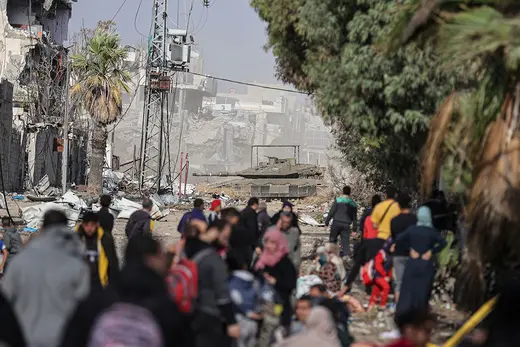
Palestinians pass Israeli soldiers and tanks as they flee south amid continuing Israeli attacks in Gaza City. Mustafa Hassona/Anadolu/Getty Images
Israel is clearly losing the battle for international public opinion because of all the civilian casualties inflicted by its military campaign. (The Hamas-run Gaza Health Ministry reported more than eleven thousand people killed before it stopped issuing updates.) To its critics, Israel responds that it tries to avoid collateral damage but that it is impossible to do so when Hamas—in violation of the laws of war—locates its military bases around schools and hospitals and uses civilians as human shields. Yet, Israel’s arguments are trumped by the emotional power of images of human suffering from Gaza.
The World This Week
A weekly digest of the latest from CFR on the biggest foreign policy stories of the week, featuring briefs, opinions, and explainers. Every Friday.
Daily News Brief
A summary of global news developments with CFR analysis delivered to your inbox each morning. Most weekdays.
Think Global Health
A curation of original analyses, data visualizations, and commentaries, examining the debates and efforts to improve health worldwide. Weekly.
By entering your email and clicking subscribe, you're agreeing to receive announcements from CFR about our products and services, as well as invitations to CFR events. You are also agreeing to our Privacy Policy and Terms of Use.
Those searing images create pressure from the Arab world and the West for Israel to end its assault. In past wars, international criticism could have been enough to bring Israel’s offensive to an early conclusion, but Israeli public opinion has been so inflamed by the October 7 attack—the most Jewish lives lost in one day since the Holocaust—that there is less likelihood of the IDF being stopped in its tracks before Hamas is defeated. But the longer the fighting goes on, the more damage is inflicted on Gaza and the harder it will be to enlist Arab regimes or the Palestinian Authority to try to rebuild Gaza post-Hamas.
More From Our Experts
There have been some attacks against Israel from armed groups in Iran’s “Axis of Resistance,” such as Lebanon’s Hezbollah and Yemen’s Houthis. What is the potential for the war in Gaza to expand to multiple fronts?
There is a real potential for Israel to face a two-front or even three-front war (from Lebanon and the West Bank), but so far all of the major actors—Israel, Iran, the United States, and Hezbollah—have acted with a degree of restraint. The entire region eagerly watched a speech delivered on November 3 by Hezbollah’s leader, Hassan Nasrallah, wondering if it would amount to a declaration of war on Israel. It didn’t. For all of Nasrallah’s fierce rhetoric, it was obvious he is not itching for another major conflict with Israel. Hezbollah is firing some rockets into northern Israel but stopping well short of a full-scale offensive. Israel’s war cabinet, for its part, considered launching a preemptive assault on Hezbollah shortly after October 7 but wisely decided not to.
A similar pattern of restraint can be discerned in the confrontation between Iran and the United States. Iran-backed militias have stepped up their rocket and drone attacks on U.S. bases in Iraq and Syria (there have been at least sixty-one incidents since October 17, but no U.S. troops have been killed), and the United States has retaliated with air strikes against Iran-backed groups in Syria. There is no indication that either Tehran or Washington wants a full-blown war, but of course, there are plenty of historical examples of countries blundering into wars they did not want.
More on:
How would you assess the U.S. response?
I would give President Biden and his team high marks for managing the conflict so far. By backing Israel’s right to defend itself and rejecting calls for a long-term cease-fire, Biden has earned credibility with the Israeli public that allows him to pressure Israel into providing greater aid to Palestinian civilians, though the toll they have sustained is far worse than the White House would prefer. Biden has also moved two aircraft carrier battle groups into the region to dissuade Iran from widening the war, but he has been restrained in his response to rocket attacks by Iran-backed groups. He does not want to become embroiled in a war with Iran.
Biden’s pro-Israel stance is politically courageous because it is costing him with his own supporters. His actions are based not on political calculations but geopolitical ones, as well as his own emotional attachment to Israel, which dates back more than half a century.